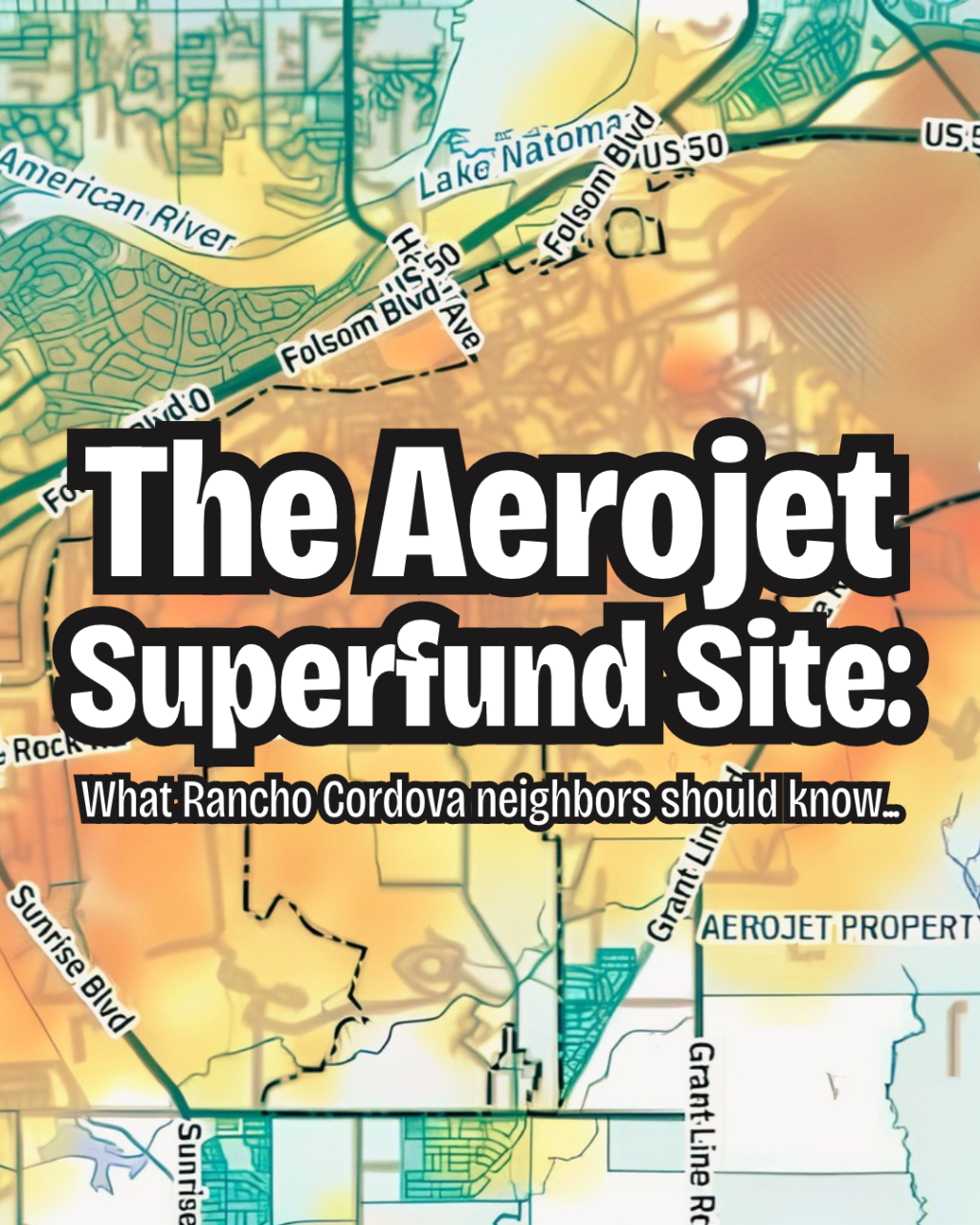
This series is about helping neighbors understand what’s happening on the land we share, and holding companies and City Hall accountable. We honor the Nisenan and Miwok peoples who have cared for this land and water for generations and whose communities are still here. Learn more through Sierra Native Alliance and Wilton Rancheria.
Up next, we’ll look at the five-year surface mining permit renewal the Rancho Cordova City Council approved on November 16, 2026, for Granite Construction’s operation on Aerojet-owned land. We’ll cover AI and data center water use in a later article, after we’ve finished our interviews and looked into whether that water use could affect the cleanup.
When I shared a video about the Aerojet Superfund site, some neighbors told me they’d known about it for years. Others were hearing about it for the first time. A few questions kept coming up. Where can I find my neighborhood on a map? How do I check my water? Who do I talk to if I’m worried about my family’s health?
I put the answers I’ve found so far in one place. This page will be updated as we get more records and answers.
Where the cleanup stands now
Aerojet manufactured rocket engines near Rancho Cordova. Chemicals disposed of at the site contaminated groundwater, including west of the property. EPA added the site to its Superfund National Priorities List in 1983. In 2001, EPA reported that nine water supply wells had already been taken out of service because of groundwater contamination. The western groundwater cleanup addresses contaminants including TCE, a solvent, perchlorate, an ingredient in rocket propellant, and NDMA. EPA’s site history · EPA’s 2001 western groundwater decision summary
The cleanup is still underway. In July 2026, the Central Valley Water Board reported that Aerojet was operating about 45 extraction wells in the Western Groundwater area and 63 in the Perimeter Groundwater area. These wells pump groundwater out for treatment and help limit the spread of contamination. Aerojet Rocketdyne operates the systems. EPA, the Central Valley Water Board, and California’s Department of Toxic Substances Control oversee the cleanup. Water Board’s July 2026 cleanup update
EPA completed its third Five-Year Review on September 29, 2026, and reported that the cleanup was “short-term protective.” That finding describes how EPA assessed the cleanup. The sections below explain where to look for test results for a specific public water system or private well. EPA’s Five-Year Review announcement
Watch the Pollution Profile video
This is the video I shared in the neighborhood groups. It walks through the site’s history and uses an illustration based on groundwater maps.
Two figures in the video benefit from some context:
- 240 years was EPA’s estimate in 2001 for restoring the western groundwater aquifer under the cleanup approach it selected at the time. EPA’s 2001 decision summary
- 88% is the share of covered remediation costs Aerojet said it could recover under a 1999 federal settlement for its Sacramento and former Azusa sites. The company said it could recover those costs through prices for products and services sold to the federal government. Aerojet’s SEC filing
Rancho Sauce hasn’t independently verified the video’s estimates of the plume’s size or the total volume of water pumped.
Where can I find my neighborhood on a map?
On the Water Board’s Aerojet page, scroll to Aerojet Rocketdyne Documents and Resources and look for 2025 (Fall) Groundwater Maps. Check the chemical, date, and depth shown on the map. The outline shows where contamination was mapped underground. To find out what reached a household tap, you also need records of which sources supplied the home and what testing showed at the time. Water Board maps and documents · Aerojet records in GeoTracker
One neighbor asked about Area 40. That’s a section of the cleanup site also called OU-10. The Water Board reported that contaminated soil had been removed and a groundwater treatment barrier installed. EPA resumed lead oversight of Area 40 in January 2025, and Aerojet submitted a plan in April 2026 for additional sampling to help EPA choose a cleanup remedy. If you’re looking at a specific street, property, or development, ask the Water Board which maps, sampling records, and land-use restrictions apply there. Water Board’s July 2026 update, page 3
Several neighbors also asked about Mather and PFAS. EPA maintains separate cleanup records for the former Mather Air Force Base. At Aerojet, EPA requested a sitewide PFAS investigation in 2025. The Water Board also reports ongoing indoor-air testing in occupied buildings at the Aerojet site. A detection on a regional map is a starting point for finding a test result. Identifying the source or what reached a particular home takes more evidence. EPA’s Mather site profile · Water Board’s Aerojet update
How do I check the water I’m drinking?
If you’re on public water, start with the supplier on your bill. Look up the latest water quality report for your specific system. A neighbor also shared California’s Public Drinking Water Watch, where you can search for public water systems and reported sampling results. If you find a result for an individual well, ask whether it was sampled before treatment and whether it was supplying customers at the time. For questions about past exposure, ask your supplier which sources served your address during the years you lived there and whether historical test results or notices are available. Public Drinking Water Watch · Golden State Water’s annual reports, including Cordova
If you use a private well, contact the Central Valley Water Board. Geoff Rader, the Water Board’s project manager for the site, told Rancho Sauce that Aerojet routinely tests private supply wells near the mapped contamination. He said he may be able to help coordinate testing for wells that could be affected. He also said Aerojet would be responsible for providing treatment or replacement water if an Aerojet site contaminant exceeds an established trigger level in a private supply well.
Before paying for a test or filter, ask whether your well is already monitored and what testing makes sense for your location. Reach Geoff at 916-464-4707 or Geoff.Rader@waterboards.ca.gov. Water Board Aerojet page · Sacramento County Well Program
What if I’m worried an illness could be related?
Neighbors have asked whether historical exposure could be relevant to cancer, thyroid conditions, or other health concerns in their families. Rancho Sauce has not established a link between those illnesses and Aerojet. We’re asking public health agencies what records are available and how residents can raise their concerns.
California did look at one specific question years ago. A 1997 preliminary state review examined newborn thyroid screening data from 1985 through 1996. In its summary of the review, California’s Office of Environmental Health Hazard Assessment says it found no positive association between living in a potentially perchlorate-exposed area of Rancho Cordova and newborn hypothyroidism. The review focused on newborn thyroid outcomes during those years. Adult thyroid disease and cancer are separate questions. California’s perchlorate assessment, page 60
- For a personal health concern, tell your healthcare provider where you lived or worked, roughly when, and what you know about the water source or workplace. You can ask whether that history is relevant to your care and whether a referral to an environmental or occupational medicine specialist would help. ATSDR guide to taking an exposure history
- For concerns about several cancer cases in a community, contact Sacramento County Public Health or the regional registry listed by the California Cancer Registry. A review can look for more cases than expected of the same or related cancers in a defined area and period. Registry data alone usually can’t establish what caused an individual illness or whether a specific exposure caused a pattern. California Cancer Registry’s community concerns guide
How can I get involved in the cleanup?
Ask to join the Aerojet Community Advisory Group or sign up for EPA updates. Contact EPA’s community involvement coordinator, Jackie Lane, at lane.jackie@epa.gov or 415-972-3236. You can ask for the next meeting date, whether there’s a remote option, and how to get meeting summaries or raise a question about the cleanup. EPA’s Aerojet Get Involved page
What Rancho Sauce is still looking into…
We’ve reached out to EPA, the Central Valley Water Board, and California’s chronic disease surveillance office. We’re looking for historical water records residents can search by address, maps that are easier to read at street level, and any local health assessments that answer more recent questions.
If you remember a well closure, a change in water service, an HOA presentation, or a notice in the mail, I’d like to hear from you. An approximate year or the name of a water company could help us find the right records. Email RanchoSauceNews@gmail.com. If you want to share a personal health experience, you’re welcome to reach out privately. For the first message, a brief note is enough. Please keep medical records and other people’s health details out of public comments. ❤️
More from local media:
- Comstock’s (2023): A look back at Aerojet’s history in Rancho Cordova, including groundwater contamination and the lawsuits that followed. The Back Story: The Rocket Company that Roared
- Folsom Times (2025): How the planned Highway 50 interchange connects to land designated as part of the Superfund site. New $182M Interchange Will Connect Southern Rancho Cordova to Highway 50
- Folsom Times (2026): What local officials said about the future of the former Aerojet property and how nearby cities might work together on redevelopment. Future Folsom 2026





Leave a Reply