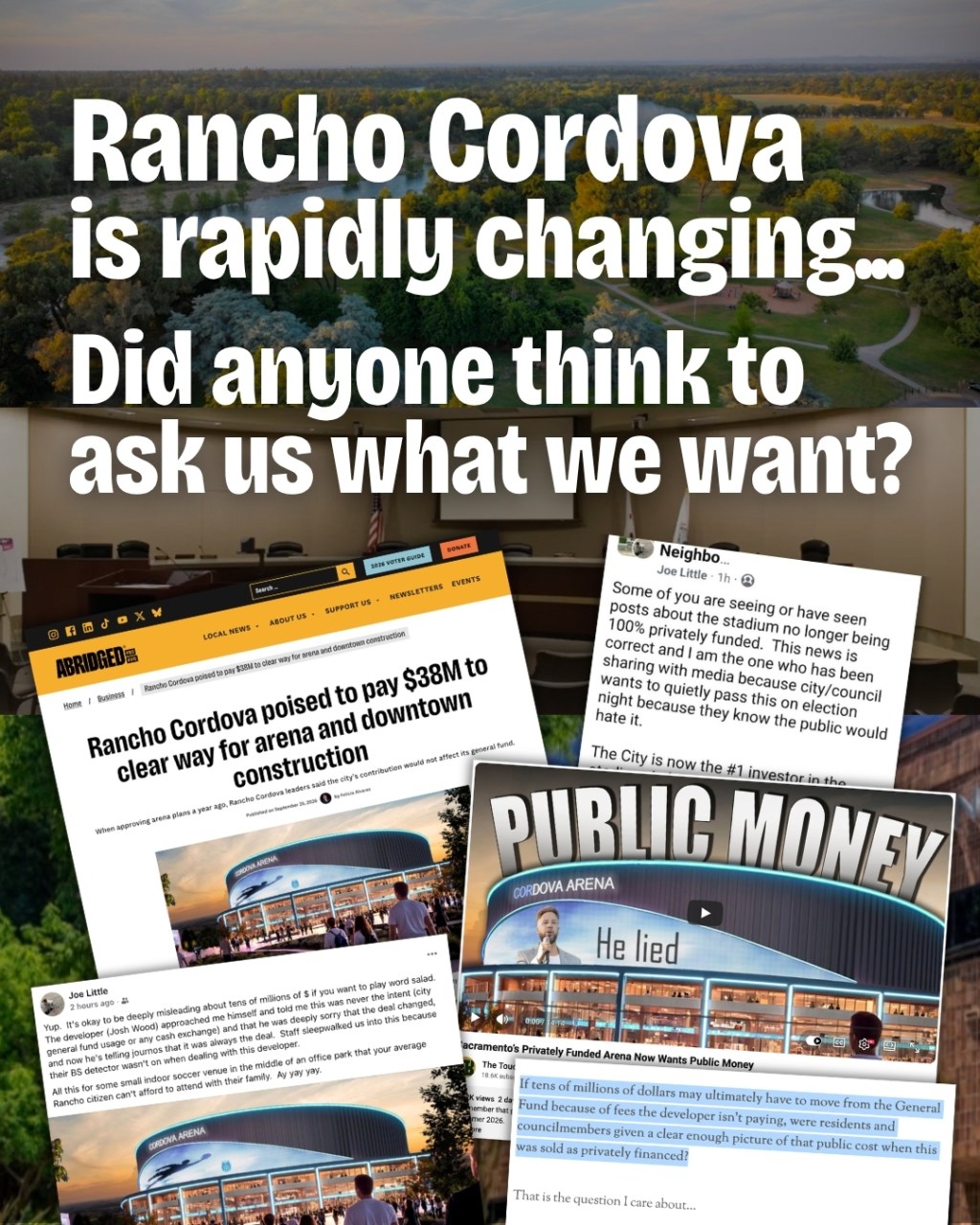
An arena and a new downtown. A $5 million AI initiative. Neighborhood scanning. A digital replica of part of the city. Tens of millions of dollars in potential public costs. All of this is moving forward while Rancho Cordova is in the middle of an election.
A note before we start: Rancho Sauce is a civilian journalism project by Rancho Cordova residents, for Rancho Cordova residents. I am not asking you to take my word for any of this. I am putting the original documents, reporting, city pages, videos and public comments in front of you so you can follow the trail yourself. This is also the first part of what will probably become a series, because there is way too much happening in this city to cram into one article.
I actually started digging because somebody said there was basically “nothing” here…
The thing that originally got under my skin wasn’t AI, public subsidies or even the arena itself. It was hearing developer Joshua Wood explain why Rancho Cordova supposedly needs a new downtown.
Wood said:
“Because if you want to do something fun, you’ve either got to go to downtown, you go to Folsom, or you go to Roseville. But, there’s really nothing here.”
…Uhhh, what Rancho Cordova is he talking about??
We have free summer concerts at Village Green, Moonlight Movies, Fourth of July celebrations, community festivals, and concerts, exhibits and other arts programming at the MACC. The Barrel District has breweries, wine, mead, spirits, food and businesses regularly hosting entertainment, while our restaurants, musicians, artists, libraries, parks and smaller businesses are constantly creating things to do. The Cordova Community Council puts on events throughout the year, and Visit Rancho Cordova exists specifically to help people find what’s happening here.
…And this isn’t just me defending my little town I love: the City of Rancho Cordova’s own events page says the city has more than 100 mostly free events throughout the year and calls Rancho Cordova “a destination for artists, adventurers and fun-lovers!”
There is culture here, Josh. There are musicians, artists, families, immigrant-owned businesses, weird little events and people building community without a billion-dollar rendering behind them. Hearing someone involved in remaking a huge piece of our city say there is basically “nothing” here doesn’t make me excited about his vision, it makes me wonder whether the people designing Rancho Cordova’s future have bothered to understand the Rancho Cordova that already exists.
WATCH: Joshua Wood discussing the need for a new downtown
That comment is what made me motivated enough to start looking around, and then I found everything else….
So, what exactly is Rancho Cordova building?
The project generally known as Downtown Dova, and more recently marketed as Cordova City Center, is planned around Kilgore Road and Trade Center Drive. The centerpiece is a 7,500-seat arena intended for men’s and women’s Major Arena Soccer League teams, concerts and other events. The larger development has included plans for housing, hotels, restaurants, retail and an outdoor plaza. The city’s original 2025 announcement described a 28-acre development with at least 800 hotel rooms and approximately 640 residential units. (Source: City of Rancho Cordova)
More recent promotional material has described an even larger eventual buildout, with up to 1,000 residential units, 1,000 hotel rooms and 144,000 square feet of commercial space. A widely shared update earlier this year said groundbreaking was targeting August or September 2026, with the arena still targeting a November 2027 opening.
It is now September 25…. And that brings us to the video that has been making the rounds on local social media…
The “$40 million” YouTube video, and what we actually know now…
A video recently circulated alleging that the arena project, originally promoted as privately financed, was heading toward a request for roughly $30 million to $40 million in public money.
When I first saw it, I did not report that allegation as established fact. At the time, the documents I could verify showed public participation, including fee waivers, city-owned land and future revenue arrangements, but I could not find documentation showing that Rancho Cordova had actually committed $40 million from its General Fund.
Then today, September 25, Abridged by PBS KVIE published new reporting.
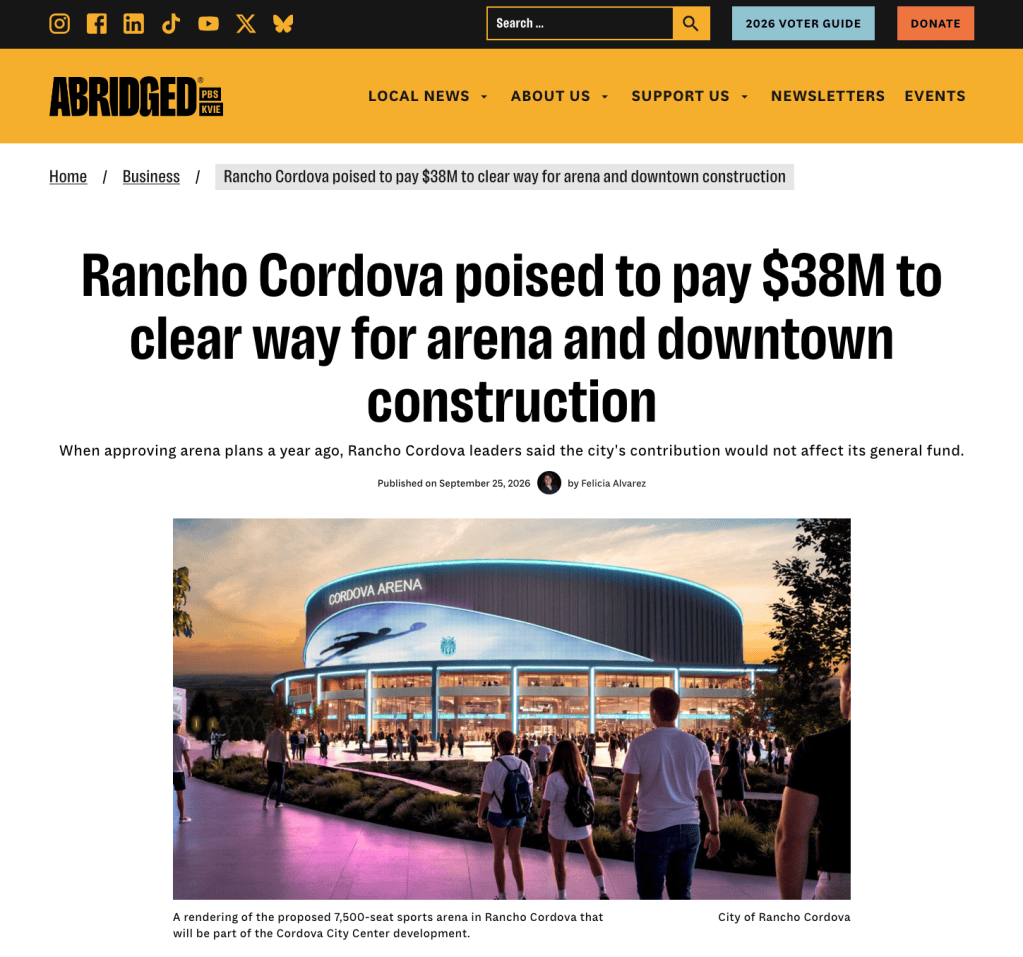
Read the September 25 Abridged/PBS KVIE investigation
WATCH: the video that started the argument
The video’s specific framing and commentary are the creator’s own, and some details were initially based on information that had not yet been publicly confirmed. But the underlying concern about potentially tens of millions of dollars in public costs can no longer simply be dismissed as “fake news.”
Abridged reports that Rancho Cordova may spend up to $38 million in public funding connected to fee waivers for the arena and larger downtown project. According to Councilmember Joe Little, city staff estimate that the city could eventually transfer approximately $38 million from its General Fund to special funds to replace revenues that would otherwise have been collected through development impact fees. (Source: Abridged – PBS KVIE)
And this distinction matters: the reporting does not say the city is writing Joshua Wood a $38 million construction check. The mechanism involves development and impact fees that would normally be paid by the project. If those fees are waived, city spokesperson Maria Kniestedt told Abridged that the city could make internal transfers from its General Fund into special funds that pay for things such as traffic, housing and public infrastructure. (Abridged – PBS KVIE)
That is considerably more complicated than “the city gave an arena $38 million,” but it is also considerably more complicated than “this is entirely privately funded.”
Because the original promises were pretty specific…
When City Council approved the project’s Economic Development and Participation Agreement in September 2025, the city described the development as privately funded. The city’s own announcement said its participation could include shared future revenue, development and building-permit fee waivers and dedication of some portion of approximately 13 acres of city-owned property, then estimated to be worth about $6.8 million. (City of Rancho Cordova)
Read It Yourself: City of Rancho Cordova —> Sept. 23, 2025 EDPA / Arena Approval
The presentation at the time went further… According to Abridged, council was told:
“The city would not be required to advance funds, pledge its General Fund, commit to establish any tax not now in existence…”
(Source: Abridged – PBS KVIE)
Councilmember David Sander said:
“The city is acting here as a partner and a facilitator, not a funder.”
(Source: Abridged – PBS KVIE)
Yet the original agreement apparently already contemplated substantial fee waivers. Abridged reports that the 2025 agreement contained provisions allowing $25 million to $40 million in fee waivers. Councilmember Little says he did not understand those waivers would ultimately require General Fund money to replace the lost revenue, telling Abridged that this consequence was disclosed after the vote. (Source: Abridged – PBS KVIE)
Wood disputes the idea that the deal has changed. He told Abridged:
“The fees being covered, waived, whatever the term is, by the city has always been a part of this.”
(Source: Abridged – PBS KVIE)
The city likewise says the development agreement has not materially changed and emphasizes that the project will still be financed primarily by private capital. (Source: Abridged – PBS KVIE)
Those positions can coexist with a very reasonable question from residents:
If tens of millions of dollars may ultimately have to move from the General Fund because of fees the developer isn’t paying, were residents and councilmembers given a clear enough picture of that public cost when this was sold as privately financed?
That is the question I care about…
One Councilmember Is Speaking Out
There is another important piece to this story, and it comes directly from someone who actually voted on the original agreement.
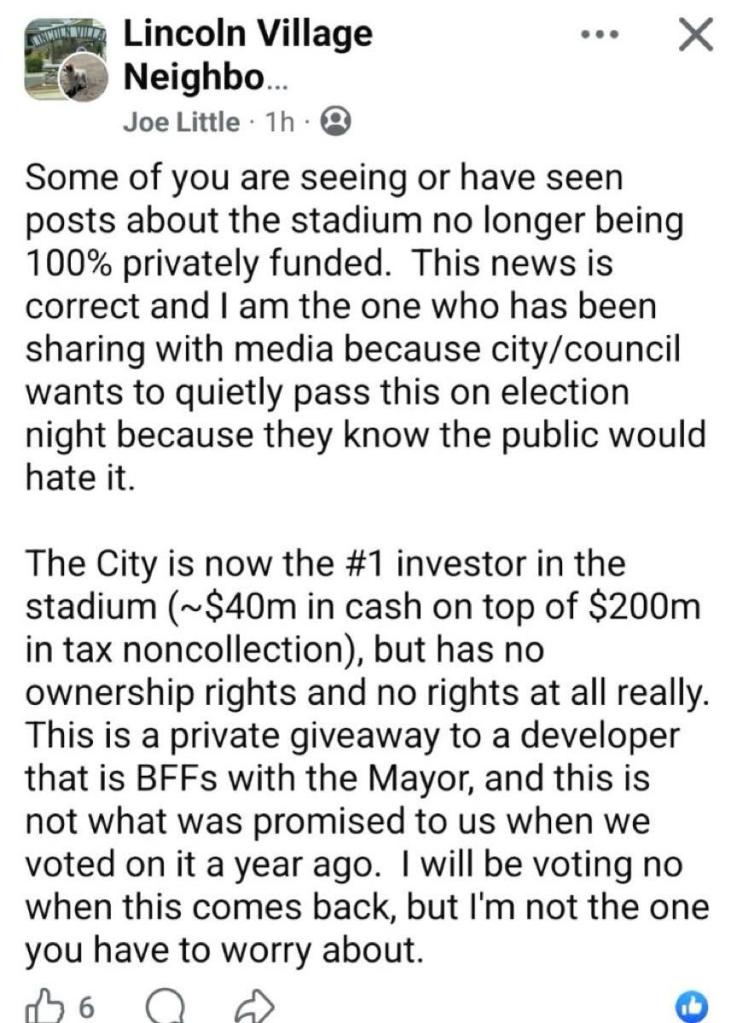
Councilmember Joe Little has been publicly speaking out about the arena financing and says he has been trying to get this information to residents and journalists. After the Abridged investigation into the proposed $38 million in City funding was published, Little shared it on Facebook with some additional information about what he says happened behind the scenes.
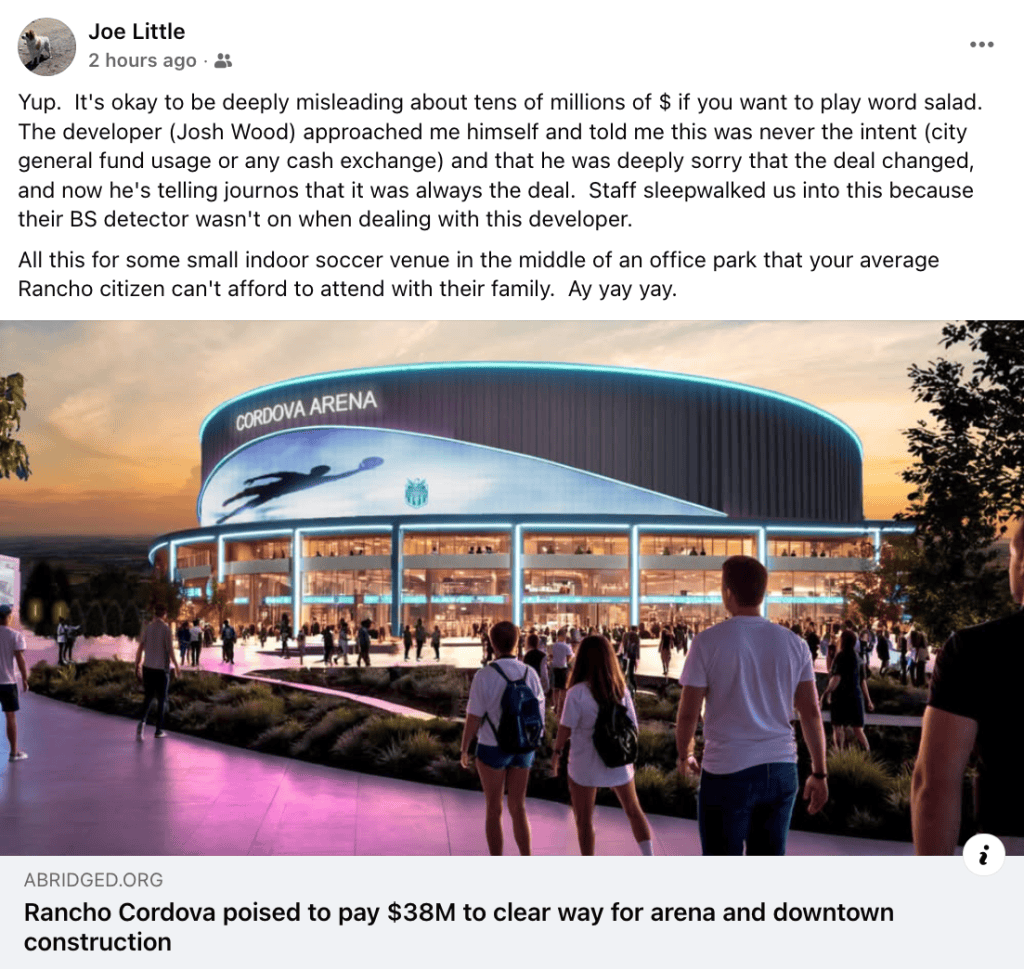
Little says developer Josh Wood personally approached him and told him that City General Fund usage or any cash exchange “was never the intent,” and that Wood was “deeply sorry that the deal changed.”
Little says Wood is now telling journalists that this was always the deal, which Little very clearly disputes:
“The developer (Josh Wood) approached me himself and told me this was never the intent (city general fund usage or any cash exchange) and that he was deeply sorry that the deal changed, and now he’s telling journos that it was always the deal.”
He continued:
“Staff sleepwalked us into this because their BS detector wasn’t on when dealing with this developer.”
This matters because one of the biggest arguments happening between neighbors right now is whether anything actually changed. Some people have pointed to the original Economic Development and Participation Agreement and argued that the fee waivers were already included, therefore this was always the deal.
Little, who actually voted on that agreement, is publicly saying that was not his understanding of what he voted for.
He has also said the City is now the project’s “#1 investor,” describing approximately $40 million in cash on top of what he characterizes as $200 million in tax noncollection, while receiving no ownership rights in return. Those are Little’s characterizations of the financial arrangement, but they’re significant considering they are coming from a sitting councilmember who voted on the original agreement.
And then, because apparently this investigation needed a sitcom subplot, I accidentally confronted what appears to be Joe Little on r/RanchoCordova. 😂
I’d commented that after watching so many council meetings, Joe sometimes looked increasingly checked-out and like he was trying to fit in with the “cool council kids.”
The original poster responded:
“I promise you I am very much not checked out!”
The account explained that they had been trying to get this information to journalists, adding:
“I pick and choose my battles carefully, you lose credibility if you fight your colleagues on everything. This one is worth it.”
The account also claimed all five councilmembers had originally been told the project used no public money and that council was later given a different interpretation. I can’t independently verify who controls a Reddit account, so I’m not treating those comments as proof of what happened inside City Hall. What makes the exchange interesting now is that Little is publicly making substantially the same argument under his own name.
So… okay Joe. 😂 I take back the checked-out part.
More importantly, this gives us something concrete to pay attention to as the project moves forward: at least one of the five people who voted on the original agreement is now publicly saying that what he understood himself to be voting for is not what he believes the City is doing today.
That’s a pretty damn important distinction.
And Little has been raising concerns about other City issues too, including Rancho Cordova’s use of Flock license-plate-reader cameras, which deserves its own investigation. (🌶️ More on that in another Rancho Sauce article very soon.)
We already know public resources are involved…
In January, City Council approved a $940,000 subsidy covering first-phase development fees. CBS Sacramento reported on that vote at the time. (Source: CBS News)
WATCH: ABC10 coverage of the $940,000 fee waiver
The city also owns land involved in the project. Its own September 2025 announcement valued the approximately 13-acre city-owned parcel at around $6.8 million and described potential land dedication and future revenue sharing as part of the city’s contribution. (Source: City of Rancho Cordova)
WATCH: Jim Amen discussing the public contributions
So the argument was never really as simple as “publicly funded” versus “privately funded.” The useful questions are what public resources are involved, how much they could ultimately cost, what the public receives in exchange and whether those terms were explained clearly before elected officials voted.
And now we have a public meeting where residents can start asking exactly that…
What can we actually do about this?
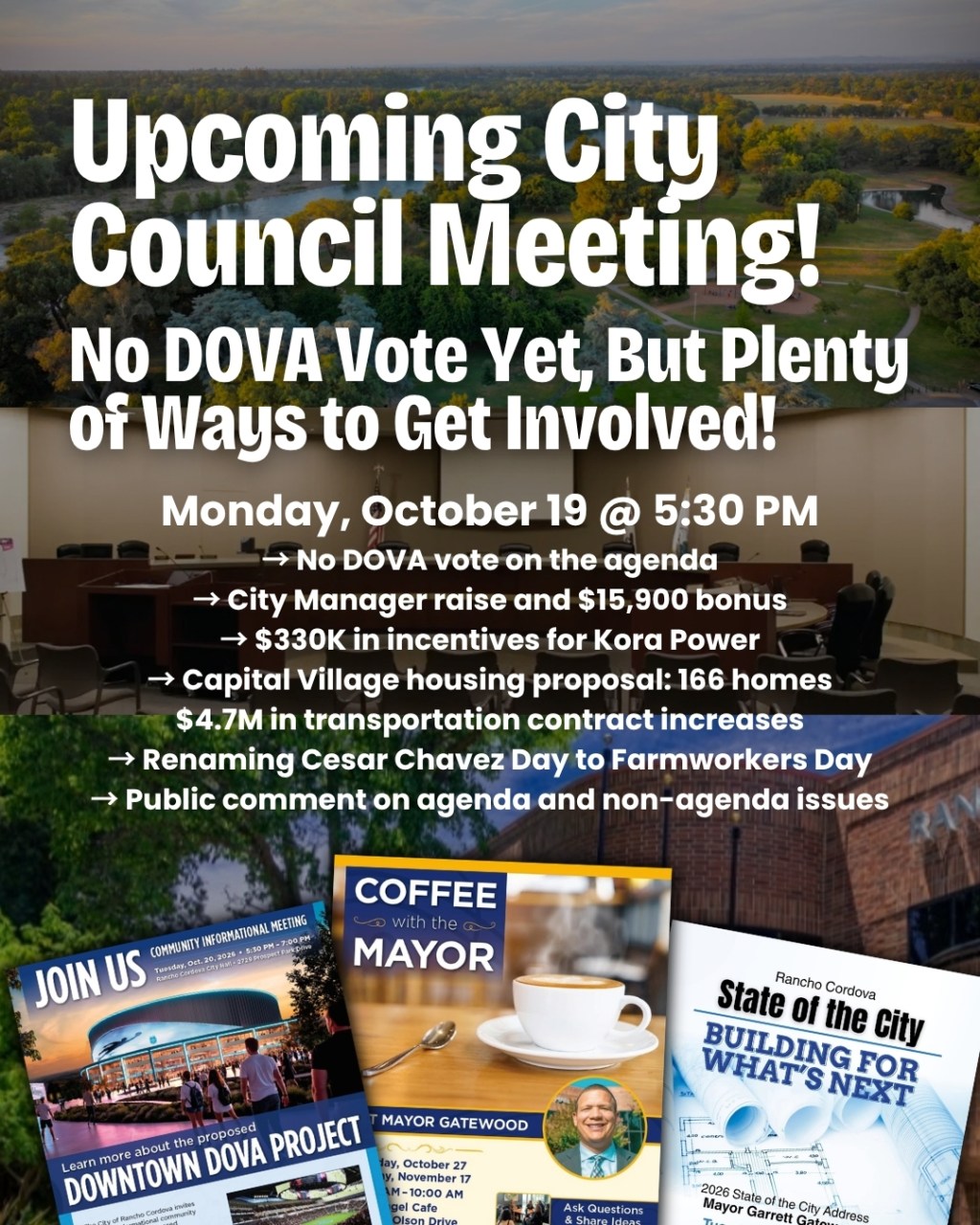
A Special Meeting of the Rancho Cordova Planning Commission is scheduled for Wednesday, September 30, 2026 at 5:30 p.m. at Rancho Cordova City Hall, 2729 Prospect Park Drive.
The public-hearing notice identifies the matter as:
CORDOVA ARENA & DOWNTOWN DOVA — Major Design Review, Development Agreement, & Determination of General Plan Consistency for the Disposition of City-Owned Property.
According to the notice shared by a resident, the current proposal includes an approximately 194,110-square-foot indoor arena with approximately 7,500 fixed seats, along with future phases allowing up to 800 hotel rooms, up to 1,000 multifamily residential units, approximately 220,000 square feet of retail, restaurant and professional-office uses, structured parking and up to 2,500 parking spaces.
One neighbor who shared the hearing notice wrote that residents were originally brought into a meeting to gain their support and were told the project would be privately funded at no cost to the city. She is now asking neighbors to contact the city and attend the hearing.
If you’re planning to attend September 30, comment on this article below. If you’d like to speak, have information or documents, or just want to sit with some neighbors instead of walking into City Hall alone, say so. If enough people are interested, we can organize an informal meetup before the meeting, compare notes and walk over together.
You don’t have to oppose the arena to show up. You don’t have to support it either.
You just have to live here and want to be more involved in local planning and politics.
And residents are already asking questions…
The comments underneath promotional videos about Downtown Dova are not uniformly negative, and I don’t want to pretend they are. Plenty of people are excited about professional sports, concerts, restaurants and having more entertainment close to home. Though I do think it’s worth noting that some positive commenters identify themselves as investors in the project or otherwise involved in ways that may personally benefit them. Take a look through the comments for yourself below.
But the same concerns keep appearing: traffic, roads, schools, infrastructure and public spending.
Under one widely shared video, residents wrote things like:
“yeah, it’s already one of the busiest exits with terrible traffic.”
“Yea, but the roads cannot support this amount of congestion.”
“640 new homes, next to an arena, and shopping center. Traffic is going to be crazy.”
“It already takes 20-30 minutes to get from Folsom blvd to Zinfandel at 3-6pm…”
READ/WATCH THE DISCUSSION YOURSELF:
Under another update, one resident asked why the city wasn’t instead focusing on opening a middle school and high school. Another complained about existing traffic, while another simply wrote, “No more tax dollars.”…
And in the Facebook discussion that erupted after the recent video, Rancho Cordova residents said things like:
“This is ill advised! This is really to put a feather in the cap. If truly approached by the public, the public probably wouldn’t vote for this project.”
Another resident wrote:
“This is truly unacceptable!! How can this happen? And, yes, our streets are still a mess from being torn up and still no fiber cable.”
Those comments don’t prove whether the project is good or bad. They prove that residents have questions, and those questions deserve more than AI-driven marketing.
Meanwhile, Rancho Cordova is making another enormous bet on its future…
While I was digging through the arena project, I kept running into something else: MORE AI!
In September 2025, Rancho Cordova announced an AI and Robotics Ecosystem involving the Human Machine Collaboration Institute, NVIDIA, Solidigm, SMUD and other partners. HMCI describes the Rancho Cordova program as a $5 million, three-year initiative involving city-scale AI infrastructure, workforce development and an innovation-governance framework. (City of Rancho Cordova)
The city now markets Rancho Cordova as a growing national hub for AI and robotics. At an August kickoff event, the city’s own invitation described the initiative as the beginning of “something big” and invited residents to meet the founders, employers, investors and civic leaders “shaping what gets built here next.” (Source: City of Rancho Cordova)
That’s not inherently bad. Training residents for new jobs could be valuable. Giving students access to technology could be valuable. Attracting employers could be valuable.
But this isn’t just a coding class…
Part of Rancho Cordova has already been turned into a digital model
The city, HMCI and Niantic Spatial are creating a digital twin of Rancho Cordova.
Niantic says its teams flew drones over roughly four square kilometers of Rancho Cordova’s “Innovation Region” and reconstructed the area into a 3D model detailed enough to read building signage and measure streets. HMCI is already using the model for traffic simulations. (Niantic Spatial)
Niantic describes the larger goal plainly: the model creates a machine-readable version of the physical city that can be used by planners, researchers and companies developing physical AI and robotics. Its announcement says the ambition is eventually to expand beyond the Innovation Region to the rest of Rancho Cordova. (Niantic Spatial)
WATCH: Rancho Cordova’s digital twin
HMCI CEO Sadie St. Lawrence described Rancho Cordova as something unusually valuable to AI researchers:
“a city willing to become a real-world laboratory where researchers, companies, and the community can safely build, test, and shape the future of physical AI together.”
(Source: Niantic Spatial)
That is an extraordinary description of the place where more than 85,000 people actually live.
The city is also using AI to survey neighborhoods
Rancho Cordova is using a system called City Detect to photograph properties while conducting neighborhood code surveys. The city says the technology has reduced surveys that previously took months to a matter of days, while a human code officer still reviews photographs before determining whether a violation has occurred. (Source: City of Rancho Cordova)
The city also says the information is used internally, that it does not store or download the photos or video from City Detect, and that the data is not shared with outside agencies. (Source: City of Rancho Cordova)
But residents are still allowed to ask questions about where the technology goes next, what data is collected, how contracts are structured, what oversight exists and whether policies will change as these systems become more capable.
Those are normal questions to ask a government.
Why are we in such a hurry?
Rancho Cordova’s official language around all of this is remarkably consistent: growth, innovation, speed, opportunity, leadership, transformation.
Mayor Garrett Gatewood described Rancho Cordova this year as “the new epicenter” of innovation and emphasized that it is one of California’s top five fastest-growing cities. (Source: City of Rancho Cordova) City Manager Micah Runner has spoken publicly about transitioning city services into a new AI era and creating a technology-forward business corridor. (Source: City of Rancho Cordova)
The city promotes the arena and AI ecosystem as transformational projects.
Maybe parts of that transformation will be great.
But faster isn’t automatically better, and growth isn’t a destination.
A city isn’t a startup. It’s a habitat. People are raising children here, aging here, running little businesses here, making music here, sitting in traffic here, paying rent and mortgages here and trying to build lives here.
Before we race toward becoming the next great AI hub with a shiny new downtown, I want to know whether the people already here get meaningful influence over what that future looks like.
City Hall is part of this story too…
I started attending and watching Rancho Cordova City Council meetings because I wanted to understand how these decisions actually get made.
What I saw didn’t exactly make me feel better.
I’ve watched Mayor Garrett Gatewood interact with people in a way that I personally read as a boys’-boy culture: casual and chummy with people inside the circle, while some members of the public are treated very differently. At the September meeting I attended, I watched an older woman speaking during public comment get interrupted and spoken to in a babyish, condescending tone, including being told to go have a “chatty chat” with “someone in the back” about her concern.
That’s my interpretation of what I watched. But you do not have to accept it.
Watch the meetings yourself: Rancho Cordova City Council agendas, minutes and videos
Spend an evening watching how councilmembers speak to each other and residents, particularly people who disagree with them. Watch which questions receive detailed answers and which are brushed aside. Watch the relationships between government officials, developers and institutional partners, then form your own opinion.
Councilmembers regularly mention having lived here for 15, 20, 30 or 40-plus years as evidence of their connection to Rancho Cordova. Longevity can provide valuable institutional knowledge, but it can also produce an insular political culture when a relatively small network of people has been making decisions together for decades. Living here for 40 years does not automatically mean somebody understands the Rancho Cordova of 2026, and our city has changed enormously.
I think City Hall benefits from something incredibly ordinary: we’re all too busy trying to survive to pay attention to what they are doing…
Most residents aren’t watching hours of City Council meetings every month. We’re working, picking up kids, making dinner, caring for family, paying bills, sitting in traffic and trying to have some kind of life afterward.
Government doesn’t stop while we’re doing that…
While we’re busy, a $5 million AI initiative can move forward, public land can enter a development agreement, development fees can be waived, millions of dollars in General Fund implications can be buried inside complicated financing mechanisms, drones can scan part of the city into a digital model, and somebody helping build our new downtown can publicly say there is basically “nothing” for us here.
So, that’s why Rancho Sauce now exists.
Oh, and this is all happening during an election…
Rancho Cordova’s municipal election is November 3, 2026, and City Council Districts 2 and 5 are on the ballot. The city’s current candidate page lists Elliott Stevenson as the ONLY qualified candidate for District 2 and Linda Budge, Lilia Darbinyan and Tegan Mauldin for District 5.
However, the write-in candidate filing period remains open through October 20, and ballots begin mailing October 5. (Source: City of Rancho Cordova)
See also: Official City of Rancho Cordova 2026 Election Information
The mayor is not separately elected citywide in Rancho Cordova. The mayor and vice mayor positions rotate annually among the five councilmembers, so these district races determine who will sit on the five-person body making decisions about city land, development agreements, incentives, AI investments, technology policy and the future physical shape of Rancho Cordova. (Source: City of Rancho Cordova)
We’re going to dig much deeper into who is running, what districts they’re running in, how to research them, how write-in candidacy works and what voters should know in the next Rancho Sauce article….
So where does that leave us?
I don’t think every new development is evil. I don’t think AI is automatically bad, and I don’t think an arena couldn’t be fun.
I want Rancho Cordova to grow.
I just don’t accept the idea that growth itself is the only goal.
I want development that improves life for the people already living here. I want infrastructure to keep pace with development, technology that gives humans more freedom instead of simply extracting more productivity from them, and local artists, musicians, businesses and community builders treated as part of our economic ecosystem rather than background scenery waiting for somebody with enough investment capital to finally make Rancho Cordova interesting.
Because Rancho Cordova is already interesting!
The question is what we’re going to become next, how much we’re willing to spend getting there and whether the people who actually live here get a meaningful say in that decision.
So don’t take my word for any of this. Read the documents. Watch the videos. Go to the September 30 Planning Commission meeting. Watch City Council. Read the city’s own marketing. Read the independent reporting. Ask candidates what they think. Ask who benefits, what we’re paying and what we’re getting in return.
And if you’re going to the September 30 meeting, want to speak, have information I should look into, or want to join a little neighbor meetup beforehand, leave a comment below.
Rancho Sauce is civilian journalism by Rancho civilians, for Rancho civilians.
We do the digging. You get the sauce. 🌶️
— Rancho Sauce 🗞️
@ranchocordovanews
More sauce coming soon: Rancho Cordova’s 2026 election, who’s running, how our districts work, write-in candidates, and what the people asking for your vote actually have power over.




Leave a Reply